
Garfield Heights City Directory Collections
Garfield Heights appears in several directory families, rather than in one uninterrupted local book. The useful starting set combines Cleveland Public Library holdings with Cuyahoga County Archives. A digitized Cleveland volume can give an immediate dated lead, while the library's microfilm and the Archives fill gaps that a browser search cannot. Check the title, edition year, and stated coverage before treating a listing as local to Garfield Heights.
| Collection | Years | Where Held | Access |
|---|---|---|---|
| Cleveland City Directories | 1930 digital volume includes Garfield Heights; 1837-1972, not inclusive, at Archives | CPL Digital Gallery and Cuyahoga County Archives | Browse online where digitized; use Archives microfilm or staff route for gaps. |
| Garfield Heights City Directory | 1954-55, 1956-57, 1962 | CPL Center for Local and Global History | Listed physical or microfilm holdings; confirm the needed edition with staff. |
| Cleveland East Suburban Directory | 1964, 1965, 1967-72, 1976, 1978-79 | CPL Center for Local and Global History | Successor suburban run for selected years. |
| Elector lists and naturalized-voter index | 1893-1982; circa 1865-1975 | Cuyahoga County Archives | Historical civic-presence records, not vote-choice records. |
These collections answer different questions. A city directory can supply a printed name-and-address clue, while an elector list or map may anchor the time and locality. The library's collection guide and the Archives catalog are the right places to ask whether a specific missing year survives.
Garfield Heights in Cleveland City Directories
The word “Cleveland” in a title should not end the search. The inspected 1930 Cleveland City Directory, published by the Cleveland Directory Company, expressly lists Garfield Heights among the covered suburbs. Its title-page description includes an alphabetical private-citizen and business directory, household and business-place listings, a street guide, map, buyers' guide, and classified directory. That makes the volume useful for both a name-first and address-first historical question.
The Cleveland Public Library Digital Gallery is the online access channel for digitized City Directories and Blue Books material. It also holds maps, yearbooks, newspapers, oral histories, and local-history books that can help test a directory clue. A digital object is still a dated publication. Keep its edition and page or image with every note.
The CPL Digital Gallery source is the entry point for browsing the library's digitized historical collections.
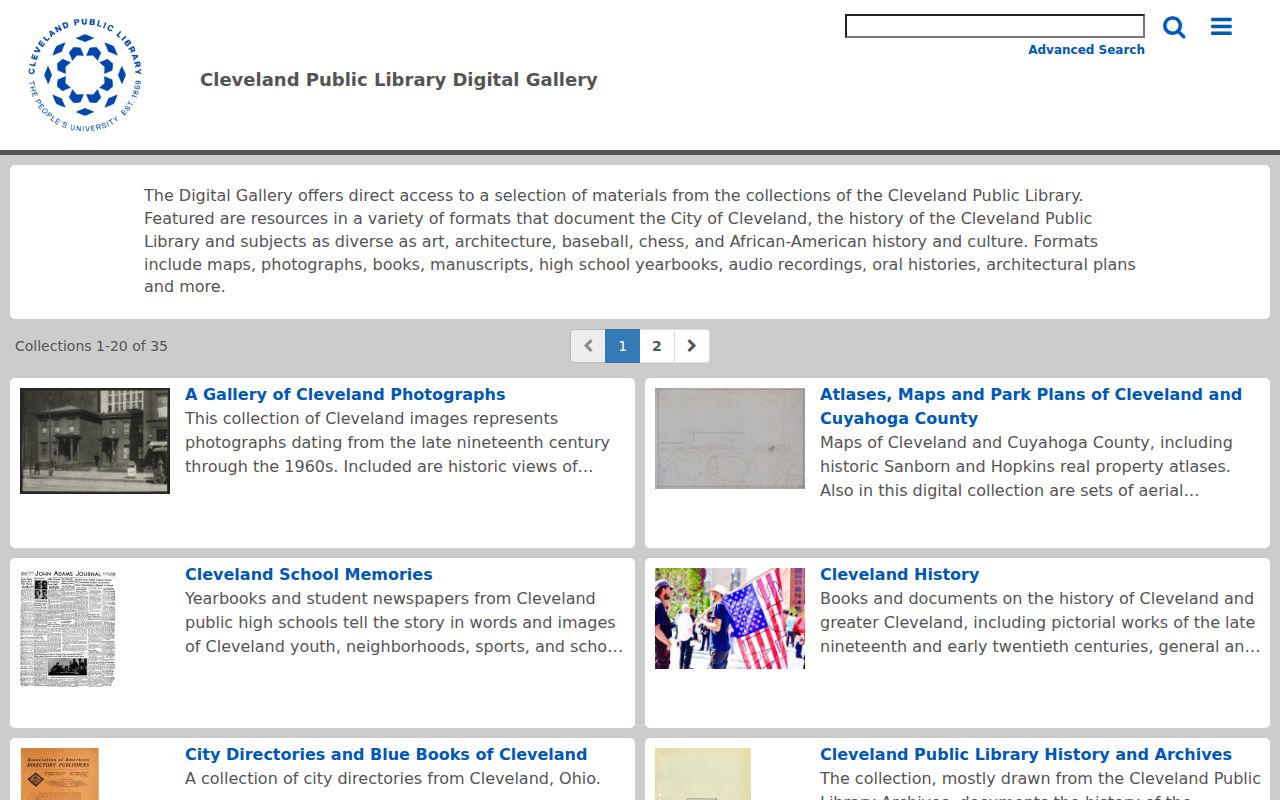
Use the collection search to locate an edition, then record its title and image or page before connecting it with another source.
The digitized 1930 directory source shows the edition's title page before a researcher turns to its alphabetic or street portions.
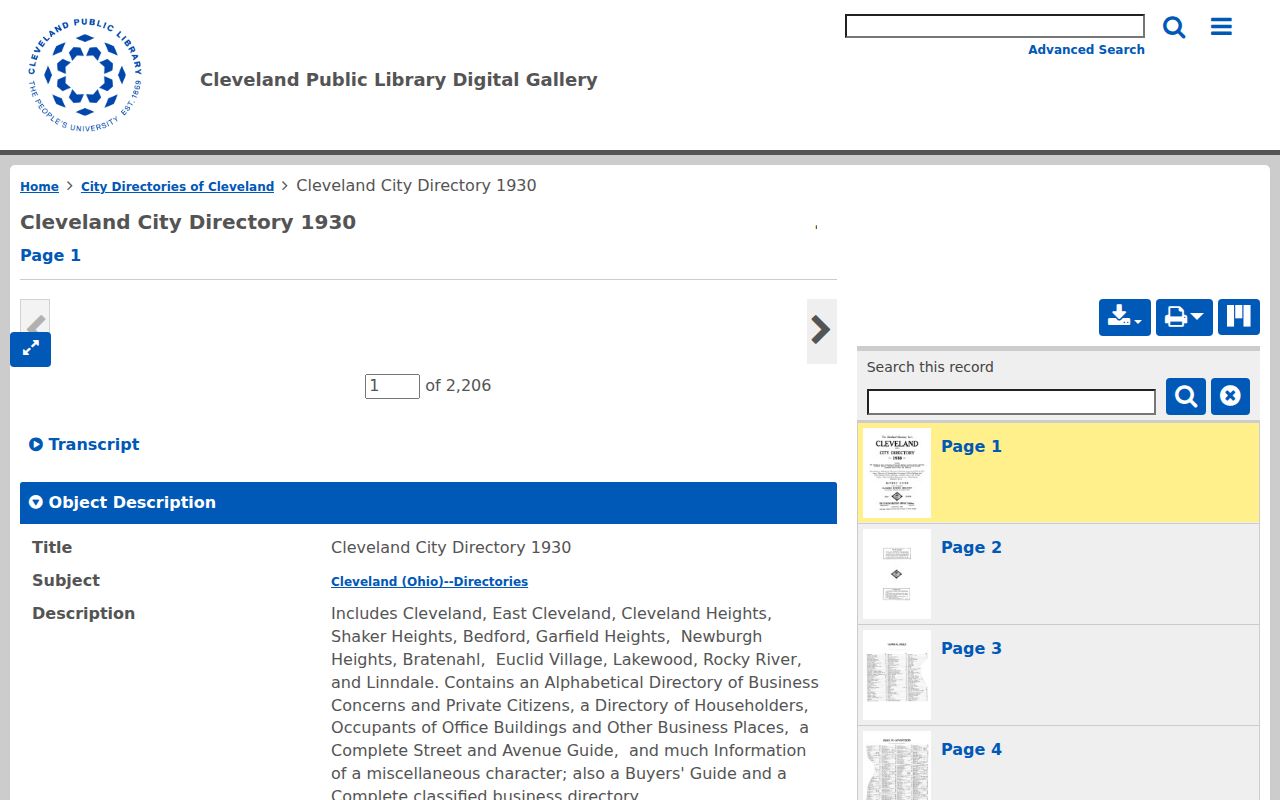
That source label matters because the directory's suburb coverage is established by the volume itself, not assumed from its Cleveland title.
Request Garfield Heights City Directory Runs
Cleveland Public Library's genealogy guide identifies a distinct Garfield Heights City Directory run for 1954-55, 1956-57, and 1962. It then lists East Suburban editions for 1964, 1965, 1967, 1968, 1969/70, 1971, 1972, 1976, and 1978/79. Some larger-suburb directories were consolidated into east or west suburban editions, so an absent stand-alone title does not prove the household is absent from the broader directory.
Ask CPL's Center for Local and Global History for the city, criss-cross, or telephone directory edition that covers the exact address and time range. The Center for Local and Global History maintains directories, maps, newspapers, yearbooks, and genealogy resources beyond a single digitized item. The Garfield Heights branch at 5409 Turney Road is a practical catalog and referral stop, but the specialist collection is the deeper directory channel. The branch lists 216-475-8178 and posted hours of Monday through Thursday 9:00 a.m. to 9:00 p.m., Friday and Saturday 9:00 a.m. to 5:30 p.m., and Sunday 1:00 p.m. to 5:00 p.m.
The Garfield Heights Branch source provides local library access and an entry point into the county system.
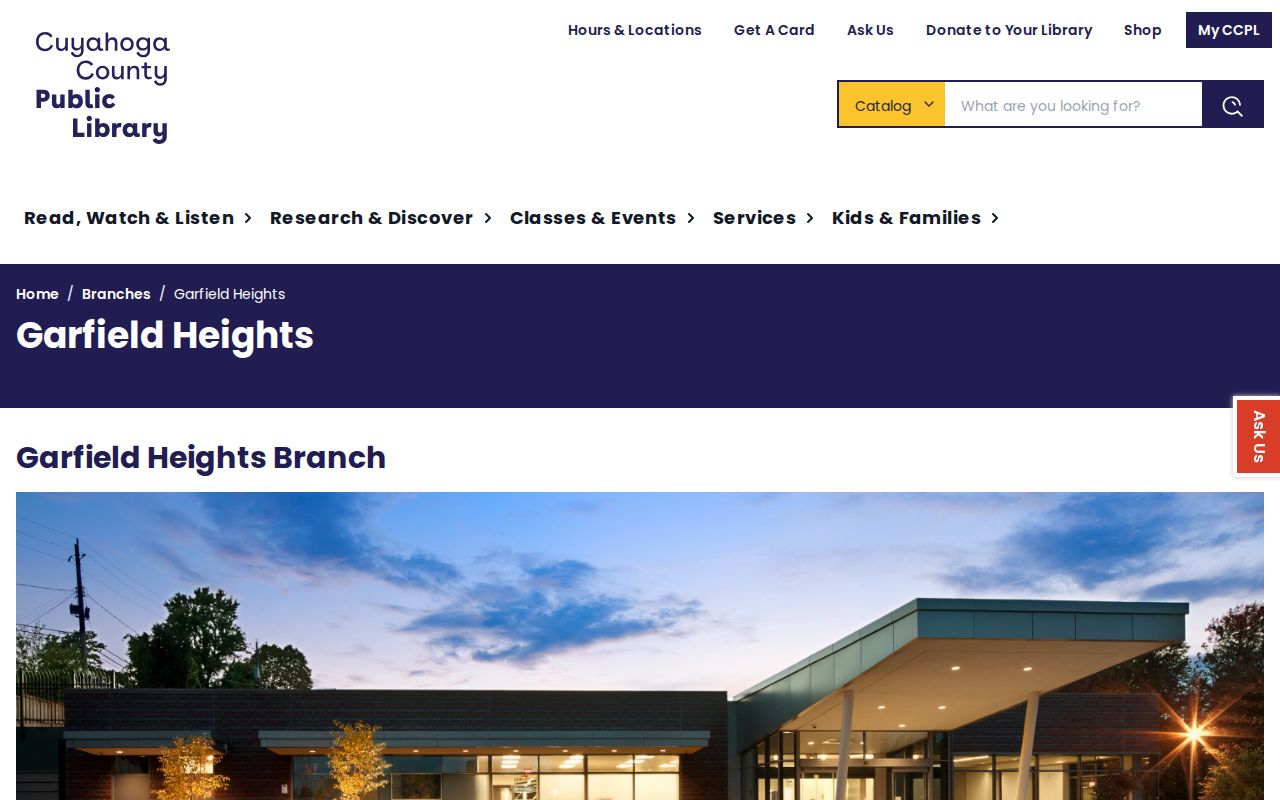
Use the branch for a local starting point, then request the exact historic volume from the collection that holds it.
Note: A listed year identifies a holding, not a guarantee that every household was printed in that edition.
Reading a Garfield Heights City Directory Entry
A directory entry should be transcribed, not expanded from memory. The inspected material confirms the book's directory divisions but does not safely supply a complete individual entry for transcription. Record only what the printed line actually shows, then read the edition's abbreviation key before deciding what a mark means. The exact printed form helps distinguish a middle initial, a former surname notation, or a same-name household on the same street.
| Name form | Printed surname, initials, suffix, and any title, spouse, or widow notation visible in the entry. |
|---|---|
| Work wording | Occupation, employer, or business text exactly as printed, if the edition supplies it. |
| Street line | House number and street, plus any home or business designation. |
| Edition citation | Directory title, year, page or image, and the edition's own coverage statement. |
| Address confirmation | The related householder, occupant, or street-guide entry, when the volume includes one. |
- Criss-cross directory
- An address-first or reverse directory section that can be checked against a name listing for the same dated edition.
- Householder index
- A section organized around an address or household reference rather than an alphabetical personal entry.
- Abbreviation key
- The book's own guide to short forms such as residence or boarding terms. Read it before interpreting a notation.
A city directory is a contemporaneous compiled reference. It can be valuable evidence, but it is not a certified record of legal title, every household member, or a person's location outside the publication period.
Garfield Heights City Directory Archive Routes
When a needed directory year is not online, Cuyahoga County Archives is the formal fallback. Its holdings list Cleveland City Directories from 1837 through 1972, not inclusive, along with maps, tax sources, property appraisal cards, elector lists, and historic vital and probate material. Researchers can use microfilm themselves, while staff retrieves non-film items. Property research is appointment based, so bring a street address or parcel number when the question turns into house history.
The County Archives research guide gives the counter, email, and mail channels. The Archives is at 3951 Perkins Avenue in Cleveland, accepts up to ten requested volumes or documents at a time, and asks email or mail requesters to supply record type, surnames, dates, page or volume information where known, and a mailing address. It states that detailed requests generally receive a response within three weeks. The first 40 photocopies are free, followed by the posted per-copy rate.
The Archives access source is the practical route for directory gaps and paired county records.
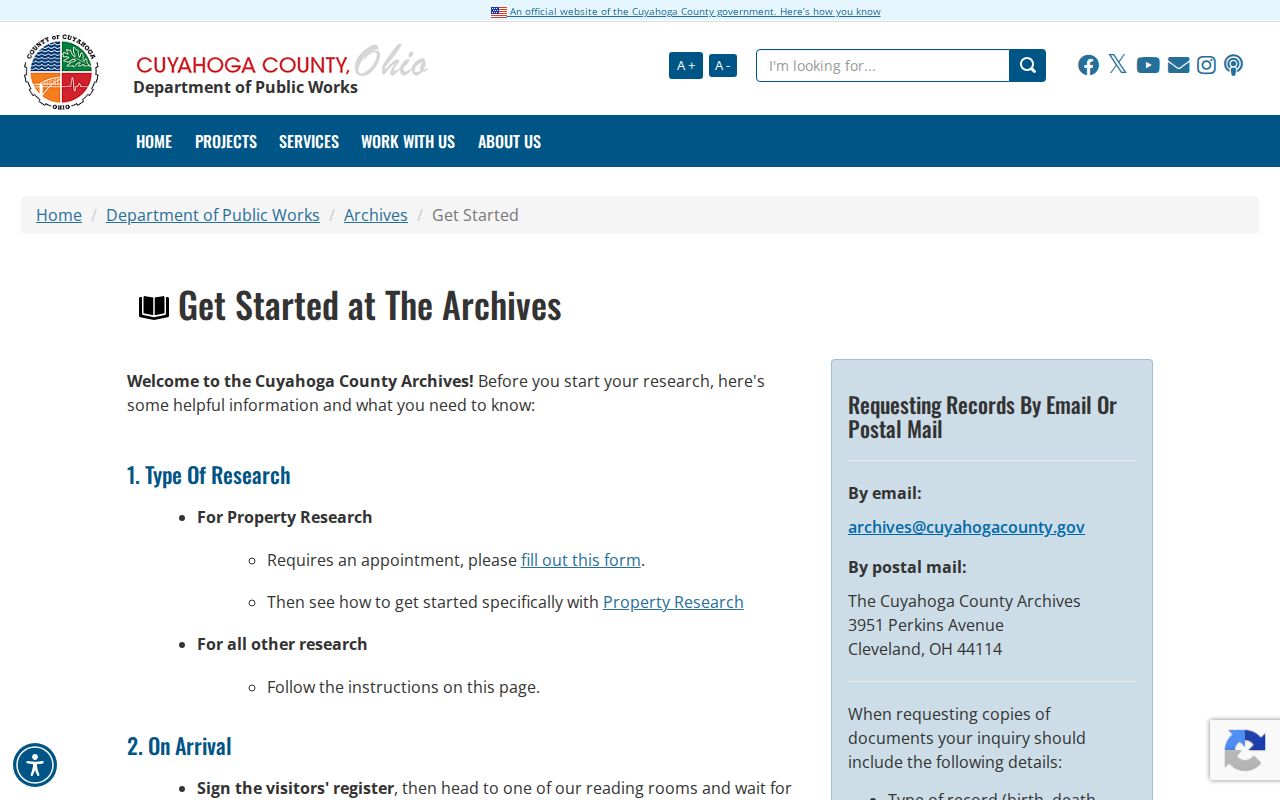
Its appointment, counter, email, and mail options are important because historical collections are not all searchable from a single screen.
The Garfield Heights Historical Society and Museum at 5405 Turney Road adds old Garfield Heights Leader issues and oral-history material. Contact it before visiting because its posted hours were listed as TBD. It is a local-memory source, not the custodian of civil records.
Garfield Heights City Directory Timeline
Directory titles reflect a local history that predates the present city name. The area separated from Newburgh as South Newburgh in 1907 and became Garfield Heights in 1930. A pre-1930 search that uses only the current name can miss a relevant place label or a broader Cleveland/suburban title. Search the historical name, current street, and parcel or legal description together when the period calls for it.
- 1837-1972: County Archives lists Cleveland City Directories across this span, with gaps noted by its “not inclusive” description.
- 1907: The area was separated from Newburgh as South Newburgh.
- 1930: Garfield Heights was established under its current name; the inspected Cleveland directory volume also expressly includes the suburb.
- 1954-1962: CPL lists the known Garfield Heights-specific directory editions.
- 1964-1979: Selected East Suburban editions provide a broader successor run.
That chronology is an Insider tip: for a stalled name search, change the place label and edition family before assuming the household disappeared. It does not support a claim that every earlier address was renumbered or that every volume covers every street.
Garfield Heights City Directory Myth Check
Myth: a city directory is a census or a current resident list. Fact: it is a publisher's dated compilation. Publication and canvassing dates can differ, some households may be omitted, and a name at an address does not establish ownership or every person in the household. A city directory should be paired with the source that answers the next question.
For a house, Cuyahoga's deed and parcel records can test a recorded property relationship. For a household, a census release through 1950 or a dated vital, probate, obituary, or map source may provide another time-stamped layer. This is why a directory citation needs both the entry and the edition year.
Trace Garfield Heights City Directory Households
Follow a household across available editions instead of treating one line as the whole story. Begin with the year nearest the event or address you know. Then test moves, spelling changes, and apparent disappearances against the next available directory, not an imagined annual series. Pair directory decades with the released federal census, which currently reaches 1950, and use official property or probate records where a relationship needs confirmation.
- Locate the first available name or street entry and preserve its exact spelling, address, and edition citation.
- Check the prior and next available city or suburban directory for a move, changed notation, or different household at the address.
- Use the same edition's criss-cross or street guide if it exists, and compare the address entry rather than guessing from a surname.
- Pair the time window with a census, map, tax record, deed, probate file, or dated obituary source.
- Keep the final conclusion narrow: a source shows a person or household at a stated address in a stated year.
When a modern address question replaces the historical one, the property chain belongs with Garfield Heights records by street, where the parcel and recorded-instrument route can be checked without overstating what the older listing proves.
Note: A disappearance can reflect a move, death, omission, changed spelling, or a missing edition, so verify it with an independent dated record.